
Candid with Deeba
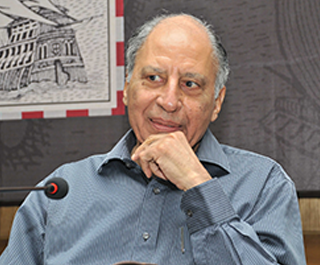
Padma Shri Keki Daruwala
Author | Poet
Welcome Keki Ji., I would like to ask you the following questions:
I can ascribe my output first thanking my wife and family. They let me write. You need commitment and a passion for writing. Any event that hit one, I tried to think how I could make a story or a poem out of it. I borrowed books (poetry) from the USIS and the British Council, and read voraciously. Poetry must get down into your system, and that can happen only if you read a lot, and now and then marvel at how the poet has managed to bring it off. I wrote on weekends.But there were periods when I couldn’t even think of writing, for instance when I was with the PM. It would be a fourteen hour day.
Am not sure if there are two separate writers—intuitive and methodical. As far as stories are concerned I do plot them, following the nebulous trail of a metaphor or trying to make a point. Poetry has to be more intuitive. I write about what hits me. Yes I did write about love and death—but what else is there to write about in poetry? Name a poet who does not talk of them. We humans differ from other living beings by being conscious of death as the end. Death-consciousness is a vital part of our mental make up, and how we face life.
Ranikhet was a lovely time. My first daughter was born, I bought a car, and we lived through two winters there. But my favourite stories would be the title one, Trojan Horse (because it is an elongated metaphor), Winter Solstice.
-
Hope Against Hope by Nadhezda Mandelstam, gives an account of their lives under the Stalin regime, the privations and the zulm.
-
Duino Elegies by Rilke.
-
The Complete Poems of Anna Akhmatova (Expanded Edition) translated by Judith Hemschemeyer.
-
Doctor Zhivago by Boris Pasternak.
-
Collected Poems of Auden.
Not really. At the moment though, the novel I am writing, presents me with a block. I don’t know how to proceed. But will get over it!I have almost never forced myself to write a poem. (Incidentally, you CAN’T force yourself to write a poem). I can think of one or two short stories I forced myself to write. One of them was Bars, it turned out well.
I am old. A week end means long hours at the newspapers, a visit to the IIC library and possibly a meal at the club. Please remember I live alone.
I have no favourite non-alcoholic drink! Perhaps nimboo-paani.
I am not fond of the word advice. I consider it presumptuous of the fellow who thinks he can give advice. Have been a low profile man all along. But my suggestions are as follows. For poets: (a) Read a lot of poetry. Go on line read from poetry journals—Poetry Chicago, Kenyon Review and a host of others. (b) Don’t fall for rhyme, to start with. Most beginners can’t handle rhyme. (c) Practise rhyme a lot, till you get control of it. Never let the rhyme run away with your poem or your lines. A time will come when the sense (I mean what you want to say) will lead and not the rhyme. (d) An outpouring of emotion is not poetry. Someone has just sent me an ‘outrage poem’ on the death of the Chinese Nobel Prize winner. Good emotions don’t make good poetry always. (e) Go for half-rhymes now and then. (f) don’t try to be too post-modern.(g) Now and then try your hand at some political poetry. (h) Avoid prosaic language, by which I mean a reporter’s language. For instance don’t write ‘unless and until’—a typical desi usage, or ‘heavenly abode’ (leave that for obituaries. (i) Lastly be demotic. Stories: Don’t spell out everything. Leave something to the reader’s imagination. And the modern stories believe in leaving the end hanging. And please ‘site’ the story – place , time etc. and go into detail . Come to the abstract after you have made a name in the concrete.
To hear him recite his poems and short stories please visit the Library of Congress New Delhi Office (The South Asian Literary Recordings Project) – https://www.loc.gov/acq/ovop/delhi/salrp/kekidaruwalla.html

